EPOMAKER Hack70 Planck Mechanical Keyboard VIA Custom 2.4Ghz/BT/Wired Gasket Hot-Swap RGB 65% Ortholinear Layout Review (2026)
Updated September 14, 2026 · Research-based review
Our verdict
EPOMAKER's Hack70 brings a rare combination to market, a wireless ortholinear board with gasket mounting, VIA remapping and a 5-layer sound-dampening stack. It suits typists curious about column grids who also want a modern feature set, though the layout demands relearning. Our score is 8.6 out of 10.
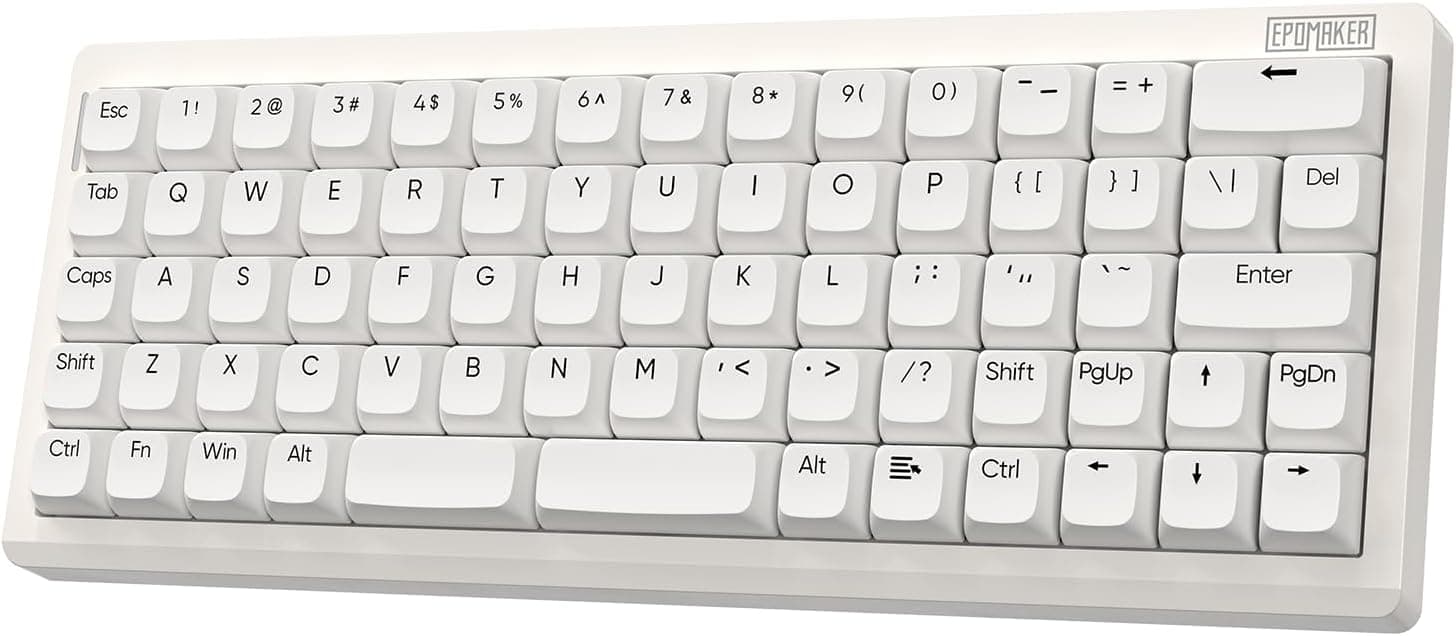
EPOMAKER's Hack70 is a Planck-style ortholinear board with gasket mount, RGB, VIA and 2.4Ghz, BT or wired connection.
Price range: See on Amazon
What we liked
- + Wireless ortholinear boards are rare, so tri-mode connection is a real bonus here
- + Gasket mount and hot-swap sockets give a softer, customizable typing feel
- + VIA lets you remap keys in a browser without compiling firmware
Trade-offs
- - Larger grid than a classic Planck, so muscle memory from other grids may not transfer
- - Newer model with less community documentation than established Planck boards
Who the Hack70 fits
The Hack70 is built for typists and hobbyists curious about ortholinear layouts, where keys sit in straight columns instead of the staggered rows found on nearly every mainstream keyboard. Because it ships wireless with Bluetooth 5.0, 2.4GHz and USB-C modes, it also appeals to anyone who wants to carry an ortholinear board between a desk and a laptop without being tied to a cable. The gasket-mounted plate and hot-swap sockets mean the typing feel can be tuned over time, making this a reasonable entry point for someone who wants to experiment with grid layouts without committing to a fully custom kit build. Anyone who has never tried an ortholinear layout should expect a real adjustment period, since years of muscle memory on staggered keyboards do not transfer directly to a straight grid.
Layout, mounting and connectivity explained
The Hack70 arranges 70 keys in a 65%-style ortholinear grid, keeping arrow keys and common control keys while dropping the numpad, similar in spirit to a Planck-style board but with a slightly larger key count. Under the plate sits a 5-layer gasket-mount acoustic system built from sandwich latex, a PE sound-optimizing film, an IXPE switch pad, EPDM foam and a bottom silicone layer, all working together to soften the typing feel and shape the sound compared with a rigid plate-mounted board. Connectivity covers Bluetooth 5.0, 2.4GHz wireless and USB-C wired, switchable on the fly, with the board remembering settings across paired devices. VIA support lets you remap every key, including the function key, directly in a browser-based tool without flashing custom firmware, which is a meaningful convenience over boards that require QMK compilation for basic remaps.
Living with an ortholinear layout day to day
The biggest adjustment when switching to the Hack70 is retraining your fingers for straight columns instead of the diagonal offsets every staggered keyboard uses, and this takes noticeably longer than adapting to a new staggered layout of a different size. Once adjusted, many typists find ortholinear layouts reduce finger travel for certain keys, though this outcome is personal and depends heavily on the layout rather than being automatic for every typist. The hot-swap sockets and gasket mount mean you can change switches to suit your preference, and the pre-lubed plate-mounted stabilizers keep larger keys like the spacebar rattle-free out of the box. For care, keep the dye-sublimated PBT keycaps clean with standard methods, and recharge the internal battery periodically since wireless ortholinear boards see less frequent releases and less charging guidance available compared with mainstream staggered boards.
Trade-offs and how it compares
In the site's ortholinear keyboards guide, the Hack70 ranks second of seven behind the Keychron Q15 Max, a metal CNC-aluminum board that scores 9.4 with a heavier, more premium build and QMK wireless support. The Hack70's larger grid spacing compared with a classic 40% Planck board, such as the Drop Planck Kit V6 also featured in this guide, means muscle memory built on a true Planck grid will not transfer perfectly, and vice versa. As a newer model, the Hack70 also has less community documentation, fewer third-party keycap sets sized for it, and fewer long-term reliability reports than established Planck-style boards that have been on the market for years. If premium materials and QMK-level customization matter most, the Keychron Q15 Max ranks higher, but if wireless convenience and gasket-mounted comfort matter more, the Hack70 holds its own.
Verdict and who should pick something else
The Hack70 earns a strong second-place ranking by delivering a combination rarely seen together, wireless connectivity, gasket mounting, hot-swap sockets and VIA remapping, all in an ortholinear layout. It is a sound choice for typists who want to try a grid layout with modern conveniences rather than hunting for a bare-bones DIY kit. Buyers chasing the most premium materials and deepest firmware customization should look at the top-ranked Keychron Q15 Max instead, and anyone who wants a true 40% Planck grid with maximum community support should consider the Drop Planck Kit V6. For a wireless, gasket-mounted introduction to ortholinear typing, the Hack70 is one of the stronger options in this guide.
Frequently asked questions
What does ortholinear mean and how is it different from a normal keyboard?
Ortholinear keyboards arrange keys in straight columns instead of the diagonally staggered rows found on most keyboards, which requires relearning finger movements even for experienced typists.
Does the Hack70 work wirelessly?
Yes, it supports Bluetooth 5.0, 2.4GHz wireless, and USB-C wired connections, switchable on the fly.
Can I remap the keys without flashing firmware?
Yes, the Hack70 supports VIA, which lets you remap every key including the function key through a browser-based tool without compiling custom firmware.
How does the Hack70 compare to a classic Planck keyboard?
The Hack70 uses a larger grid than a classic 40 percent Planck board, so muscle memory from a true Planck layout may not transfer directly, and it has less community documentation as a newer model.
Prices change often, so check the current price and availability on Amazon.
Check price on AmazonMechKeeb Lab may earn a commission from the link above.